Sublets in German Colony, Jerusalem
A sublet in the German Colony is an apartment in a small south Jerusalem neighbourhood between Katamon, Talbiyeh and Baka. Emek Refaim Street runs through it, and beside the stone houses the Templers began building in 1873 stand 1960s and 1970s blocks and newer low-rise buildings. Since July 2025 the street has also been a light rail construction site. Before you commit, ask which way the apartment faces, whether it has a safe room and where you'll park.
Where it is: Emek Refaim, Baka and the Greek Colony
Emek Refaim forks off Derech Beit Lechem (Bethlehem Road) opposite the First Station compound, just south of Liberty Bell Park, and runs south almost dead straight. From Kikar Hakhmei Yavan, where it crosses Rachel Imenu Street, you're already in the Greek Colony, and the street ends at Oranim junction, where Katamon, the Katamonim (Gonenim), Baka, Mekor Haim and Talpiot meet.
The border with Baka is Park HaMesila, which here runs along HaRakevet Street. Officially the neighbourhood is called Emek Refaim, but Jerusalemites just say HaMoshava, “the Colony”. And it's small: 1,930 residents in 2017. Nothing free on your dates? Look in the Greek Colony too, or across the park in Baka.
The Templers: what's left of them on the street
The Templers, Christians from Württemberg, bought land from the people of Beit Safafa at the northern end of the Refaim valley, about a kilometre south-west of the city as it was then. They built a German village, only in Jerusalem stone instead of timber and brick: one- or two-storey houses with cellars and tiled roofs. In the Second World War many of them were deported to Australia, and after 1948 new immigrants moved into the houses.
They still mark the northern end of Emek Refaim: the community hall at 1 Emek Refaim has become an Armenian church, and their school, at number 3, was absorbed into the Orient hotel, which has a display on the Templer settlement on its lower floor. Many of the side streets are named after non-Jewish supporters of Zionism, such as Émile Zola and Tomáš Masaryk.
What apartments there are, and what about a safe room
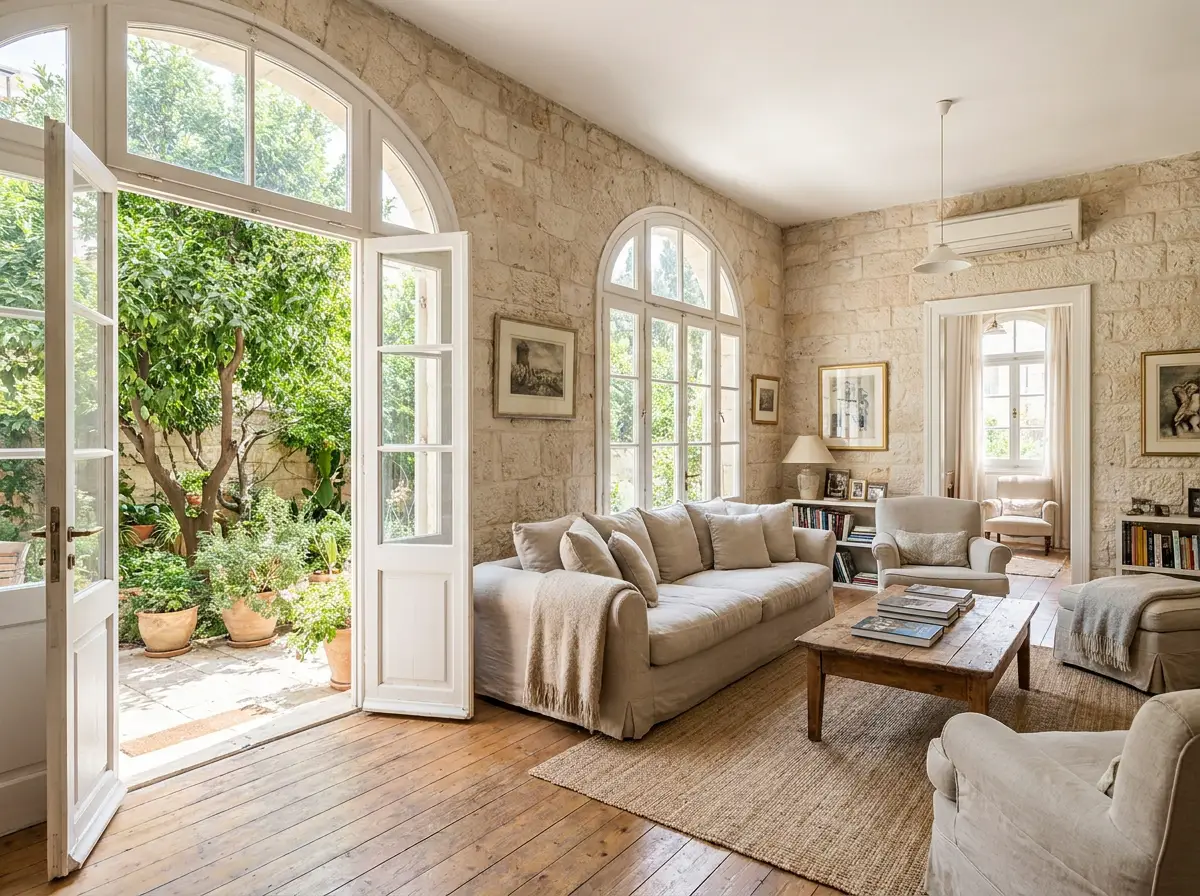
An apartment in the Colony can belong to any of three layers. The Templers' stone houses, and south of them homes built by well-off Arab families. Apartment blocks from the 1960s and 1970s, which did little for the neighbourhood's looks. And since the 1980s, once conservation became a concern, every new building has followed the old ones: low, with a tiled roof, arched windows and a courtyard.
And a safe room (mamad)? The duty to build a protected space into every new building only came into force in 1992, and the stone houses and the 1960s–70s blocks were built before it. Buildings like these rely on a shared shelter, some don't even have one, and then people take cover in the stairwell. Ask the host what there is, and check how many minutes it takes to reach the nearest shelter.
Getting around: the coming light rail and Park HaMesila
For the next few years, the first question here is the light rail. After residents protested, it won't run through Park HaMesila: in October 2020 it was finally decided that it will run along Emek Refaim. It will be the Azure (Tchelet) Line of the Blue Line project: from Malha through Talpiot to the Rachel Imenu stop on Emek Refaim, then past the old station and along Keren Hayesod and King George to the city centre. On the published timetable it is due to open in 2029.
Since the work began in July 2025, you can't drive Emek Refaim end to end, and many bus routes have been diverted away from it. Plan your daily commute on that week's situation. And even after opening, through traffic won't return.
On foot or by bike, there's Park HaMesila, which starts by the old station. The railway route was chosen in the first place for its gentle gradient, and that's rare in Jerusalem: a long walking and cycling path with no real climbs. Except that in 2025 part of its northern stretch was torn up for the Blue Line and the heavy rail extension. And the city centre? It's close, which is one reason the neighbourhood is in demand.
Who a German Colony sublet suits, and who it doesn't
Some call it the Sheinkin of Jerusalem: since the 1990s cafés, restaurants, bars and boutiques have opened along Emek Refaim. English speakers won't be alone here, and researchers will find the Shalom Hartman Institute in the neighbourhood. By the way, the Jerusalem Pool, on the street itself, reopened at the end of 2023.
Now the unvarnished part. This is an expensive neighbourhood: affluent families who moved in pushed property prices up. An apartment facing Emek Refaim hears the street and, until the light rail opens, the works too, so ask which way the bedrooms face. Coming with a car? Check whether the apartment has private parking, because you shouldn't count on the street itself.
Sublets in German Colony, Jerusalem: frequently asked questions
Where is the border between the German Colony and Baka?
Park HaMesila, which runs along HaRakevet Street, separates it from Baka. And along Emek Refaim, from Rachel Imenu southwards you're already in the Greek Colony.
When will the light rail start running on Emek Refaim?
In 2029, if the timetable holds: that's when the Azure Line from Malha through Emek Refaim to the city centre is due to open. Until then the street is a building site, and some buses detour around it.
Do German Colony apartments have a safe room (mamad)?
It depends on when the building went up. A protected space only became mandatory in 1992, so the stone houses and the older blocks usually don't have one, while a building put up after 1992 should have a safe room in the flat or on the floor. Ask the host.
Is the German Colony a good fit for olim and English speakers?
Yes. A large English-speaking community lives here: families and singles, olim who came to stay and people here for a while. If you'd rather correspond in English, say so when you contact the host.
How does payment work, and do you need the landlord's consent?
There's no renter fee on Home Sublet. The host receives rent and deposit directly from you at the key handover. And yes, you do: make sure the landlord has agreed to the sublet before you commit.
Sources
More guides
- How to find a sublet in Tel Aviv or Jerusalem
- Subletting in Israel: what it is and what the law says
- How much a sublet costs in Tel Aviv and Jerusalem
- Student sublets near Tel Aviv University and the Hebrew University
- Sublet with a mamad: how to check the safe room before you book
- Sublet agreement: a free template, plus the landlord’s consent letter