Sublets in Nachlaot, Jerusalem
A sublet in Nachlaot is a furnished apartment for a month or longer in one of the old courtyard neighbourhoods between Agrippas Street and Bezalel Street, right by the Mahane Yehuda market. Many Nachlaot apartments are in old stone houses and don't always have an elevator or a safe room, but the location is hard to beat: the city centre is a walk away and the light rail runs along Jaffa Road. Before you send a request, it helps to know what each alley gives you.
Nachlaot: 32 small neighbourhoods around Mahane Yehuda
Nachlaot isn't one neighbourhood but a cluster of 32 small ones, built outside the Old City walls between 1875 and 1933. Even Yisrael came first; later ones include Mishkenot Yisrael, Mazkeret Moshe, Ohel Moshe and Zikhron Yosef. And the name? It's the plural of nachala, Hebrew for an estate or inheritance, most likely because several of the neighbourhoods are called Nachalat something: Nachalat Zion, Nachalat Achim, Nachalat Yaakov. In other words, a flat advertised as being in Ohel Moshe or Zikhron Yosef is in Nachlaot too.
A few parts of the cluster reach Jaffa Road. The Mahane Yehuda market, the shuk, runs between Jaffa Road on the north and Agrippas on the south, and on Thursdays and Fridays it fills with Shabbat shoppers until it shuts on Friday afternoon. These days it's also an evening spot, with bars, restaurants and live music. At the other end, on Bezalel Street, stands the Beit HaAm cultural centre (formerly the Gerard Behar Center), and the Pargod Theater was founded in the neighbourhood in 1969.
Who a Nachlaot sublet suits, and who it doesn't
A sublet in Nachlaot works for people who want to live in central Jerusalem without a car: students, families on sabbatical, new olim, and remote workers who like a lunch break at the shuk. And the neighbours? Religious families, mostly in the renovated and newer houses, and plenty of students and young people in the old ones. Small synagogues are tucked all through the alleys. The most ornate is the Ades Synagogue in Nachalat Zion, built in 1901 by Jews from Aleppo, where the bakashot, hymns sung on Shabbat through the winter, are still kept up.
Light sleepers shouldn't take a flat on Agrippas or Jaffa Road, and certainly not one facing the shuk's bars. On Shabbat the market is closed, and neither the light rail nor the train to Tel Aviv runs from Friday afternoon until Saturday night. Arriving with a stroller, lots of luggage or knees that hate stairs? Check which floor the flat is on and how many steps lead up to the door.
Nachlaot apartments: stone houses, courtyards, and what to ask about elevators and safe rooms
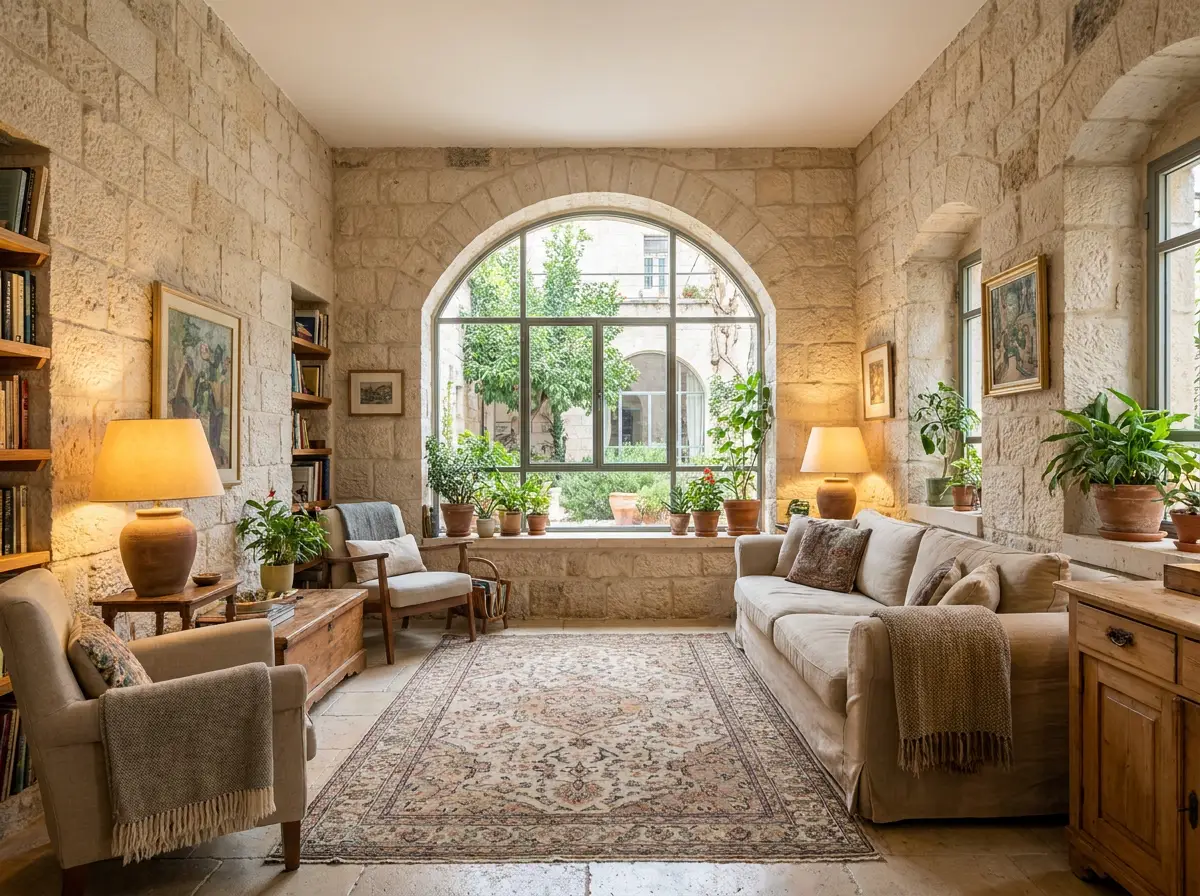
The first houses were built of local stone, single-storey and set around an inner courtyard; from the early 1900s the courtyard disappeared and the neighbourhoods were laid out along narrow alleys. In Zikhron Yosef, built under the British Mandate, houses go no higher than three floors. After 1948, with overcrowding, many flats were extended without permits, so ask the host how many square metres the flat has and how it's laid out.
Don't assume an old low-rise house has an elevator. A safe room isn't a given either: these houses stood for decades before the Gulf War led Israel to require a mamad, a reinforced safe room, in every new residential building. Ask where the nearest shelter is. On Home Sublet, hosts can mark a mamad, an elevator or a Shabbat elevator on the listing, and sometimes the answer is already there.
Getting around: the light rail on Jaffa Road, and the centre on foot
The light rail's Red Line (L1) runs along Jaffa Road on Nachlaot's north side. The stop by the market is Mahane Yehuda, with HaTurim and HaDavidka on either side. Since August 2026, HaTurim has also been the end of line L3, which crosses the Hebrew University's Givat Ram campus on its way to Malha. One stop west of HaTurim, Central Station sits right next to Yitzhak Navon railway station, with trains to Tel Aviv and Ben Gurion Airport.
The city centre is within walking distance, and Sacher Park, the largest public park in central Jerusalem, is close to the edge of the neighbourhood. Parking is another story. The alleys are narrow and winding, so if you're bringing a car, ask the host where you'd park before you commit, and don't assume a residents' parking permit comes with the flat.
When to look for a sublet in Nachlaot: semester and summer
With so many students in the old houses, the Hebrew University calendar is worth knowing. The academic year usually opens in October, after the autumn holidays, and the first semester ends in January or early February. Coming for a semester? Start looking a few weeks before it opens.
The second semester usually ends in late June or early July, and the next year doesn't open until October, about three months later. That gap is exactly when a student's flat can come free for a sublet. It suits anyone in Jerusalem for the summer, or anyone who wants to try the neighbourhood before a year-long lease.
Sublets in Nachlaot, Jerusalem: frequently asked questions
Do apartments in Nachlaot have a safe room (mamad)?
Not necessarily. Most houses in the neighbourhood are far older than the mamad requirement, though buildings from the mid-1990s on usually have one. Ask the host whether there's a mamad or a shared protected space on the floor, and if not, how far the nearest public shelter is.
Can I rent in Nachlaot for a weekend or just for Shabbat?
Not here. Stays on Home Sublet run from a month up to a year, and each host sets their own minimum. For a single Shabbat or a weekend, look for a short-term holiday rental.
How much does a sublet in Nachlaot cost, and how do I pay?
Each host sets a monthly price, shown on the listing. Home Sublet charges renters no fee, and there's no agency fee. Rent and deposit go straight to the host at the key handover, in cash or by a local transfer you've both agreed on, and only after the host has approved your booking request.
Is it noisy living next to the Mahane Yehuda market?
It depends on the alley. A flat facing the market, Agrippas or Jaffa Road will hear the Thursday and Friday crowds, and the bars in the evening. Deeper into the alleys, it's quieter. Ask the host what the flat sounds like on a Thursday evening.
Do I need the landlord's permission for a sublet in Israel?
Yes. Under section 22 of Israel's Rental and Borrowing Law, the host needs the landlord's consent to sublet, given in advance and in writing. A host who uploads it to Home Sublet gets a “landlord approved” badge on the listing. No badge? Ask to see the consent before the keys change hands.
Sources
- Hebrew Wikipedia: Nachlaot
- Wikipedia: Nachlaot
- Wikipedia: Mahane Yehuda Market
- Hebrew Wikipedia: Beit HaAm (Jerusalem)
- Wikipedia: Sacher Park
- Wikipedia: Red Line (Jerusalem Light Rail)
- Wikipedia: Jerusalem Light Rail
- Wikipedia: L3 (Jerusalem Light Rail)
- Transportation for Jerusalem: Line L3 (in Hebrew)
- Wikipedia: Jerusalem–Yitzhak Navon railway station
- Hebrew Wikipedia: Protected space (mamad)
- Hebrew University: Academic calendars
- Nevo: Rental and Borrowing Law, 5731-1971 (in Hebrew)
More guides
- How to find a sublet in Tel Aviv or Jerusalem
- Subletting in Israel: what it is and what the law says
- How much a sublet costs in Tel Aviv and Jerusalem
- Student sublets near Tel Aviv University and the Hebrew University
- Sublet with a mamad: how to check the safe room before you book
- Sublet agreement: a free template, plus the landlord’s consent letter